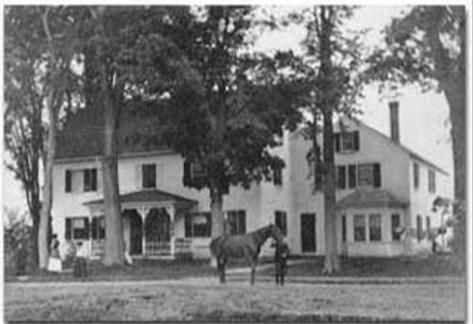
The Eastman Family
 William Kimball Eastman
William Kimball Eastman (1794-1887) was born in Loudon, NH to David and Ruth Carter Eastman. After attending school, William became an apprentice at a local bakery. When that failed to interest him, he traveled to Limerick, ME to learn to be a tanner and currier. Becoming proficient in that trade, he decided to go into business for himself. Eastman chose Conway West as a good location for his business.
The next few years were busy ones for William. In 1815 he bought a tannery near Pequawket Pond in Conway, in 1816 he married Rhoda Messer, also of Loudon, and moved her up to Conway. Eastman had purchased land across from the tannery to build his home on. In 1818, his house was completed. William and Rhoda had 9 children over the next thirty years, and all lived in the house.
Eastman began to add several more businesses to his name over the years in the Conway area. He bought a shoe and harness-making business in 1827, started a general store out of his house with some of his sons in 1833, and began to add on to their house as a result. Along with being a businessman, Eastman was involved with local politics, was a Lt. in the Militia, along with being a selectman and the coroner.
Eventually, most of the Eastman’s children moved out of New Hampshire, some to California and the others to Minnesota. The ones in Minnesota made their money in the lumber trade or from their creation of a flour mill. That mill eventually became the Pillsbury Flour Company. William and Rhoda made frequent trips to Minnesota to see their children, but sadly Rhoda fell ill after a trip in 1870 and passed away. William continued to live in the house with his daughter Caroline Calista Barnes until 1879. Eastman sold the house and moved to Minnesota to live with his children. He passed away in 1889 and was returned to Conway.
The Heath Family

In 1879, George A. Heath (1836-1900) bought the house with his first wife Elizabeth (Harriman) Heath. He was born in Conway and later fought in the Civil War as a private in the NH 18th Regiment. After the war, Heath bought two 100 acre plus farms in Madison, NH and later sold both farms. Heath purchased our house in 1879 and in 1880 his wife passed away. George and Elizabeth had one child, George Henry (1860-1944).
Heath married his second wife, Lucinda (Meader) Heath (1846-1928) in 1883. She was born in Chatham, NH and was married before George to Dana Leavitt. George and Lucinda had one child, Ray A. Heath. George later worked at the peg mill (down the street from the house), sang in the Methodist choir, rode a bicycle around town and played tuba in the Conway Band. On June 21, 1900, George died mysteriously on the back of the property. He and Solomon Dinsmore went to work in the back fields and only Dinsmore returned. When he was found, it was noted that even though he was found in water, his lungs were not filled with water. George Heath’s heirs then sold the property to A.C. Kennett (yes, that Kennett). Two weeks later, he sold it to Mary E. (Daniels) Lord.
The Lord Family

Eben Lord (1846-1922) was born in Madison, NH to James Lord and Lydia Gile Kennett. His father passed away when he was eleven years old. In 1864, Lord enlisted in the army but was mustered out ninety days later: the Civil War was over. After the war, Lord was working as a stable hand, which was perhaps the beginning of his love of horses. He also married Abbie Smith that year, but it was a short marriage, as she passed away not long after. In 1882, Lord married Mary Daniels of Plainfield, NH and bought a farm in Hanover, NH. They lived there for nineteen years before purchasing the “stately” Eastman House on Main Street in Conway.
While living in the house, Eben and Mary had three children. Leon Albert (1883-1914), Flora Pearl (1888-1953) and Robert Raymond (1892-1967). The Lords owned several parcels of land around the house, but Eben’s chronic drinking led to most of the land being sold off throughout the years. Mary had a millinery shop in the house for a time, selling hats and accessories. She passed away in 1921 after battling cancer. Eben followed in 1922. Robert Raymond “Bowser,” continued to live in the house for many years.
The back barns had been added to the house around 1850, and an apartment was built in the back of the house. Bowser lived there, since the main house did not have plumbing. On January 20, 1962, the Lord’s son, Robert Raymond “Bowser” Lord gave the house to the Conway Historical Society. He lived on in the caretaker’s wing until his passing in 1967. Over the course of its history, the house was used as a residence for almost 150 years by only three families.


…and many other nooks and crannies
filled with interesting artifacts, displays, tools, treasures and whatsists.

100 Main Street
Conway, NH